Account
Items 1-12 of 9996
Views:
Items 1-12 of 9996
The most listed brands in Server Memory are Dell, Hynix, Samsung, HP, Micron and Kingston. Every listing names its manufacturer and part number, so you can search by either.
Both. Of the 50,001 listings, 12,949 state a condition: 8,946 are refurbished and 4,003 are new. The other 37,052 do not record one, so ask for it when you request a quote. The condition shown on a listing is the condition you receive.
9,964 Server Memory listings show a price you can order at. Items marked "Call for Price" have a Request for Quote button; send the part number and quantity and the sales team replies weekdays between 8:00 am and 5:00 pm PST.
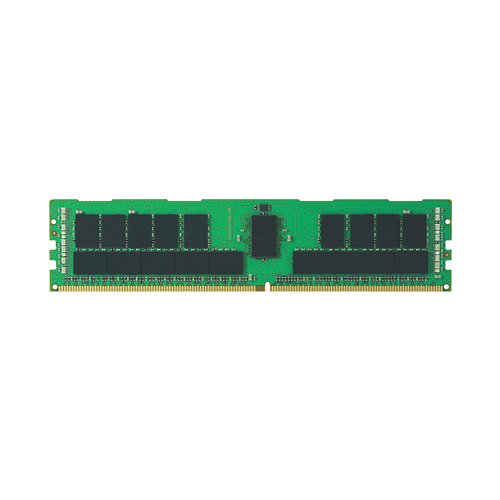
Server memory is error-correcting (ECC) DIMM memory built for servers and workstations: Registered DIMMs (RDIMMs), Load-Reduced DIMMs (LRDIMMs), and unbuffered ECC modules, across the DDR3, DDR4, and DDR5 generations. Choosing the right module comes down to four checks: the DDR generation your platform accepts, the module type already installed (RDIMM, LRDIMM, or UDIMM cannot be mixed), the capacity and rank your slots support, and the speed grade. Memory Clearance supplies server memory in new and refurbished condition (what each grade means), with Samsung, Hynix, and Micron OEM modules behind Dell, HPE, Lenovo, and Cisco part numbers.
Start with the DDR generation. DDR3, DDR4, and DDR5 DIMMs are keyed differently and are physically incompatible: a DDR4 server cannot take DDR5 regardless of the spec sheet. Your platform documentation, or an installed part number read from iDRAC (Dell) or iLO (HPE), settles this in seconds. The catalog carries DDR4 and DDR5 modules, plus DDR3 parts for platforms past end of life.
Match the module type second. RDIMMs are the default in Dell PowerEdge and HPE ProLiant systems. LRDIMMs buffer the data lines as well as command and address signals, which is what enables 64GB-and-larger modules at full slot population. Unbuffered modules are workstation-class, and most two-socket servers will not accept them. The three types never coexist in one system: add what is already installed, or replace the full bank.
Then capacity, rank, and speed. Rank (single, dual, quad, octal, written 1R/2R/4R/8R in codes like 2Rx4) is one of the factors that sets how many modules a memory channel supports, so match rank when adding to an existing bank. Speed downclocks to the slowest module in the system: a faster module works but buys nothing. CAS latency (CL22, CL42) follows the same rule. Blade servers (Dell M-series, HPE BL-series) often require VLP (very low profile) modules; standard-height DIMMs physically do not fit.
Finally, order by part number when you have one. A Dell or HPE branded module and its Samsung, Hynix, or Micron OEM equivalent are the same module under different labels; quote any number you have and include your server model. Quotes are answered weekdays 8:00 am to 5:00 pm PST.
No. Registered and load-reduced modules use different buffering and a system will not run both. Install the type already present, or replace the full bank.
A memory module has no moving parts, and its specification is fixed by the part number, not its age. The condition shown on a listing is the condition you receive; warranty terms are on the warranty page. See condition grades.
PC4 marks the DDR4 generation and 25600 is the peak bandwidth in MB/s per module, which corresponds to DDR4-3200. A trailing R means Registered. The same decode works across generations: PC3-10600R is DDR3-1333 registered, PC5-38400 is DDR5-4800. Full decoder: how to read memory part codes.
Read an installed part number from iDRAC or iLO and search it here, or browse by platform generation above. If the exact number is not listed, request a quote with the number and your server model; equivalent part numbers usually exist.
Quantity, not price, is usually the constraint on a large secondary-market order. In Server Memory we hold 1,393 distinct parts with 25 or more units available, 286,444 units in total. Depth varies by part number, so a volume request is answered against the exact number you need.
Send the part number, the quantity, the condition you will accept and the server model. A platform's population rules decide how many modules it can take, so settle those before you size the order. Send a volume request through the contact form, putting the part numbers and quantities in the message, or read how to get quantity pricing. Quotes are answered weekdays 8:00 am to 5:00 pm PST.
Each collection below is this category narrowed to one specification, on its own page with its own listing count. Start there when you already know the generation, interface, capacity or family you need.
Every collection by specification