Account
Items 1-12 of 4236
Views:
Items 1-12 of 4236
The most listed brands in Network Cables are HP, Apple, Dell, Belkin, IBM and HPE. Every listing names its manufacturer and part number, so you can search by either.
Both. Of the 4,236 listings, 1,636 state a condition: 1,120 are refurbished and 516 are new. The other 2,600 do not record one, so ask for it when you request a quote. The condition shown on a listing is the condition you receive.
1,018 Network Cables listings show a price you can order at. Items marked "Call for Price" have a Request for Quote button; send the part number and quantity and the sales team replies weekdays between 8:00 am and 5:00 pm PST.
Network Cables is a mixed bin, not one part type. Of the 2,417 listings with a stated product type, 1,486 are Network Cable, 327 are Data Transfer Cable, 266 are Power Cable and 108 are Server Interface Module, with smaller counts covering Audio/Control, Control, Video and Phone cables. Compatibility with a specific system, such as a MacBook Pro or a PowerEdge server, is called out on 425 listings. The category holds 4,236 listings across 82 brands, led by HP, Apple, Dell, Belkin, and IBM.
For switch-to-switch and switch-to-server links, choose between a direct attach copper (DAC) assembly and an active optical cable (AOC): one fixed-length part, not a cable plus separate optics. DAC is passive and cheaper over short runs; AOC carries its own laser and reaches farther. Stacking cables linking switches within one chassis family are just as specific: order the exact part number for your switch generation, not a generic length. HPE, Juniper, and Mellanox parts here sell this way.
Fiber patch leads bring a different decision: single mode against multimode, the OM or OS grade, and the connector pair. Single mode (OS1, OS2) uses a narrow core for long runs between buildings; multimode (OM1 through OM5) uses a wider core for shorter data-centre links and costs less per lead. The fiber listings here include OM4 duplex leads terminated LC to LC. An LC connector will not mate with an SC housing, and a multimode lead will not carry a single mode signal, so match grade and connector on both ends.
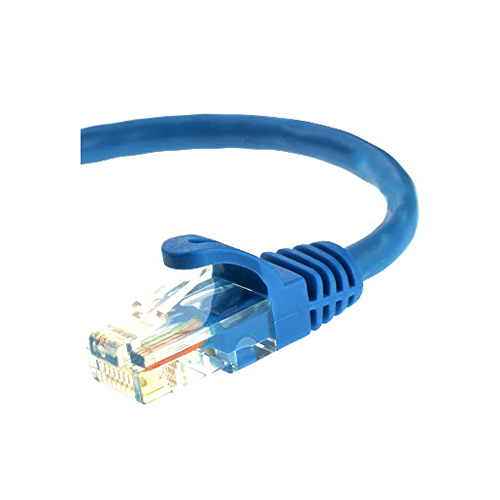
For plain copper Ethernet cable, category and shielding set the ceiling. Cat5e is rated for Gigabit Ethernet over the full 100 meters, Cat6 adds headroom for 10 Gigabit but only to about 55 meters before falling back to Gigabit, and Cat6a carries 10 Gigabit the entire 100 meters. Shielding is called out on 57 of the listings here; treat an unlabeled cable as unshielded. Cable length is recorded on 1,400 listings, led by 3 m (193), 5 m (158), and 1 m (153). A DAC or AOC is fixed length end to end, so measure first.
Order by the part number on your existing cable or switch. Condition is stated as New on 479 listings and Refurbished on 1,091; the remaining 2,666 record none, so ask for it when you request a quote. Listings without an online price carry a Request for Quote button; quotes are answered weekdays 8:00 am to 5:00 pm PST on (800) 733-1169.
A direct attach copper (DAC) cable is a fixed-length twinax assembly with a connector, usually QSFP or SFP, molded onto both ends; it is passive and needs no separate transceiver. An active optical cable (AOC) uses the same connectors but carries a laser and fiber inside, reaching farther at a higher price. Both ship as one part number for the exact length needed and cannot be resized.
Not always. A DAC or AOC cable carries vendor identification the same way a transceiver does, and many switches check that code before linking up. A cable built for one vendor can be refused, or run at a lower speed, on another vendor's switch, even with a matching connector. Match cable to switch brand and generation; the third-party optics guide covers vendor coding.
Single mode fiber (OS1, OS2) uses a narrow core and a laser source built for long-distance runs between buildings. Multimode (OM1 through OM5) uses a wider core for shorter data-centre links, and the two are not interchangeable: a multimode transceiver will not read a single mode signal correctly. Check the OM or OS grade printed on the jacket first.
Cat5e is rated for Gigabit Ethernet over the full 100 meters. Cat6 adds headroom for 10 Gigabit, but only to about 55 meters, falling back to Gigabit past that. Cat6a runs 10 Gigabit the entire 100 meters. Check the printed category on the jacket: a longer run on lower-category cable quietly downgrades speed instead of failing.